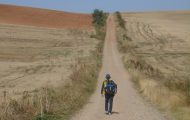
In June 2019, I completed the last 115 km of the Camino De Santiago, from Sarria to Santiago De Compostela. As the Camino stretches for almost 800 kilometres, this was only the start of my journey.
This blog documents my journeys on the Camino de Santiago, detailing my experiences of walking various routes since 2019. I’ll share insights about my pilgrimages, including the Caminos Frances and Portuguese, as well as other related trips.
The posts reflect on the physical and emotional aspects of my travels, cultural experiences, and passion for exploration, with plans for future long-distance adventures.
Tue 2 June 2026 Villar de Mazarife to Astorga [29.65 km] 0 km Villar de Mazarife 7.1 km Villavante 11.1 km Puente de Orbigo 11.4 km Hospital de Órbigo 14.1 km Villares de Órbigo 16.8 km Santibáńez de Valdeiglesias 24.8 km San Justo de la Vega 29 km Astorga At just under 30 km, this stage turned out to be the longest of this Camino, but at least the weather was not quite so hot as the previous nine days and, for most of it, the terrain was quite flat. The day started with a long trek to rejoin the main road from León to Astorga that I’d detoured from the day before. It was a bit monotonous, to be honest, but the thought of reaching one of the most impressive structures on the Camino Francés kept me pushing on through the featureless landscape.
El Puente de Paso Honroso in Hospital de Órbigo is one of the longest bridges on the Camino Frances and a stunning sight, consisting of 20 spans across 200 metres from end to end. The bridge is famous for an event that took place in the Holy Year of St James, 1434, known as the “Passo Honroso” or “Honorable Pass”. A knight named Suero de Quiñones, along with his followers, challenged other knights to a jousting tournament to prove his love for his lady. The tournament lasted for a month, and Suero and his companions emerged victorious. The event has been immortalised in literature and legend, and the bridge is now a popular destination for pilgrims and tourists alike.
On the other side of the Órbigo river, I stopped for a coffee at a pop-up cafe, owned by a gentleman with an keen interest in football, judging by the shirts that were hanging on the wall. There were a couple from South Korea, a Sporting Gijon top and even an Everton jersey.
As I approached my final destination for this Camino, the spires of the Astorga cathedral towered in the distance. After 10 days on the road, my feet were starting to ache and I was looking forward to taking a rest, especially as I had splashed out €90 on a room at the Hotel Spa Ciudad de Astorga, which had a relaxing swimming pool in the basement, including a very soothing jacuzzi. There didn’t seem to be a lot of choice in the way of food, until I found Bar Goyo Burguer restaurant, which served tasty meals at very reasonable prices.
Bar Goyo Burguer restaurant, Astorga
Before leaving Astorga the following day, I took a look inside the cathedral, which was a lovely way to spend some time before catching the bus to León to catch the train to Madrid.
As I was leaving the cathedral, I bumped into Sigi, who was on her way to her next destination, somewhere past Astorga. For me, my Camino was over for now, but she was on her way to Santiago.
Today’s Playlist This Year’s Model (album) Big Tears / Radio Radio / (What’s So Funny ‘Bout) Peace Love & Understanding (bonus tracks) – Elvis Costello & the Attractions It Was What It Was podcast (w/Tim Vickery, discussing Brazil in the FIFA World Cup) BBC Radio 4 – This Cultural Life with Eric Idle Today’s Stats Total Steps: 39,952 Distance Covered: 29.65 km Calories Burned: 3,931 Finally, some updated figures… 221.43 km [137.59 miles] – Distance covered on this Camino Frances, from Burgos to Astorga. 1,861.43 km [1,156 miles] – Total distance walked since I took my first step on the Camino on 7 June 2019, equal to travelling overland from Amsterdam to Rome.
Mon 1 June 2026 León to Villar de Mazarife [21.9 km] 0 km León 4 km Trobajo del Camino [León city limit] 7.2 km La Virgen del Camino 9.2 km Oncina de la Valdoncina (for Villar de Mazarin) 20.5 km Villadangos del Páramo 20.6 km Villar de Mazarife
As beautiful a city León might be, the usual walk through its suburbs as you leave on the Camino is not very pretty, taking you, as I discovered last time I did this, next to a busy highway that had a steady stream of trucks thundering past at rather close quarters, so I decided to try an alternative route which was a little further but supposedly less urban.
Before I reached this diversion, I came across a couple of interesting landmarks on the outskirts of León. First, there was a curious restaurant called Babu Afrika that described itself as a Colonial Tavern which seemed extremely out of place which, I discovered later, had closed down about a month earlier. Next, I passed the Basilica of Virgen del Camino, a striking, modern church in Valverde de la Virgen that was constructed in 1961.
Shortly after the basilica, I veered off the trail. Whether this was worth the extra leg work is open to debate, but I’m pleased I tried it, though not sure if I’d do it again, though Bar La Parada in Chozas de Abajo, the only cafe that breaks your journey, was excellent. run by a very friendly couple who offered free, tasty chicken wings as tapas with your drink.
As I was approaching Bar La Parada, I took my first wrong turning on this Camino. I’d been chatting to Eric, from Columbus, Ohio, as we walked, and he said he was stopping at the cafe, so I carried on walking… in the wrong direction for about 300 metres down the road. Thankfully, a couple of Guardia Civil officers drove past and pointed out my mistake. I’ve been told that these guys will provide a sello [stamp] for your credencial, but I didn’t have the nerve to ask for one.
I eventually reached Villar de Mazarife, another village with limited facilities, where I bumped into Kiwi Dan, who pointed me in the direction of the Spar supermarket, run by an eccentric woman who fussed around like a mother hen.
Again, this was a one-bar town with no restaurants open, as my albergue didn’t serve food on Mondays, so I bought a few cans of beer, some bits of food from the shop and spent the evening in my room.
Today’s Playlist The Last Flight – Public Service Broadcasting Total Steps: 29,529 Distance Covered: 21.9 km Calories Burned: 3,094
Sun 31 May 2026 Reliegos to León [21.79 km] 0 km Reliegos 5.9 km Mansilla de las Mulas 10.7 km Villamoros de Mansilla 12.2 km Puente Villarente 16.3 km Arcahueja Pasarela peatonal 24.6 km León
This was a pleasant, stress-free walk to León, passing through the lovely town of Mansilla de las Mulas, which, in retrospect, would have been a better place to stay for last night’s football. Oh well, maybe next time…
As with other large towns and cities on the Camino, the spires of León Cathedral are visible from quite a distance as you approach the city. I was walking with Sigi from Frankfurt, so we both took the obligatory photos of the cathedral in the distance. Neither of mine are worth sharing.
As we approached the city centre, our attention was drawn to a family of storks who were nesting on the top of a church bell tower. It was an impressive sight, especially when one of the parent storks launched itself into the air, its massive wings flapping in the midday sun. This was the second stork’s nest I’d seen that week, which shouldn’t have come as a surprise as, according to Wikipedia, Spain is home to more than 50,000 white storks, as opposed to less than 250 in the UK.
León is also known for having a museum that contains the Chalice of Doña Urraca. In 2014, authors Spanish authors Margarita Torres and José Ortega del Rio claimed that it could be the Holy Grail, though I suspect that the word ‘could’ is doing a lot of heavy lifting in this assertion. We arrived in the city after the basilica that houses this relic had closed, so I couldn’t view the item. I had to make do with a picture postcard.
Famous for its kings, who inspired the name of a popular rock group of the 2000s, León is a lively city, dominated by its Gothic cathedral, which happens to be directly next to the small apartment where I’m staying. I don’t think I’ve stayed in accommodation with such a magnificent view.
The last time I was here, I visited the cathedral and it’s a stunning building, with a large plaza at the front that is dominated by big, block letters that spell out the name of the city for tourist photo opportunities.
In the afternoon, I dropped into El Espumoso León, a rock bar, with cheap beer and decent tapas. It also supported Cultural Leonesa, the local football team, who currently play in the Spanish Segunda División.
One small disadvantage of entering cities as a pilgrim is that you hardly ever see the Camino companions you’ve made over the previous week, and that was the case this time, though I met Sigi later in the evening at Molly Malone’s Irish pub.
It was another very hot day on the Camino, but that was like saying, “Is the Pope a Catholic” at that time, though, coincidentally, Leo XIV was due to arrive in Spain less than a week later, the same day that I was scheduled to leave the country.
Today’s Playlist The Eggpod Express podcast discussing Disc & Music Echo magazine from 14 May 1966 Part 2 [featuring David Quantick] Total Steps: 29,357 Distance covered: 21.79 km Calories Burned: 3,055
Sat 30 May 2026 Sahagún to Reliegos [28.64 km] 0 km Sahagún 4.8 km Calzada del Coto 10.4 km Bercianos del Real Camino 14.2 km Calzadilla de los Hermanillos 17.7 km El Burgo Ranero 30.6 km Reliegos
At 28.6 km, this was the longest stage of this Camino and, towards the end of six hours on the road, I was feeling the pace.
After a hearty breakfast of bacon and eggs at Cafe Asturcón across from my hotel in Sahagún, I headed out at 7 am. The first 17 kilometres were quite pleasant, with friendly locals and a return to a convenience store that I’d visited five years ago. At that time, there’d been a hopscotch grid painted on the road, so I was amazed to see that it was still there.
When I mentioned this to the shop owner, she was pleased to find out the English name for this game, so now I know that the Spanish for this activity is rayuela. Apparently, it’s also popular in Germany.
I also saw a new creature on the Camino for me, as a couple of large lizards scuttled across the path in front of me.
Apart from skirting the Autovia Camino De Santiago, this stretch followed the train line from Sagahún towards León. I responded by putting my arm in the air at one of the trains, reminding me of a poem titled “Waving At Trains” by one of my favourite poets, Roger McGough [https://exceptindreams.livejournal.com/322174.html? ]
The lines of my favourite poet, Philip Larkin, often come into my head whenever I enter a church on the Camino. I’ll let you find that out for yourself.
I stayed at the same albergue in Reliegos that had welcomed me five years earlier. It was a one-bar town then, but it was a memorable watering hole, called Bar Elvis, which was owned by quite a character and had graffiti inside and outside the building. Unfortunately, while Bar Elvis was still there, it had closed down, so another bar had taken the role of the only bar in the village.
As this bar wasn’t showing the European Champions’ League Final between Arsenal and Paris Saint Germain, I listened to TalkSport radio’s commentary on the radio as I drank a bottle of cheap wine in the garden of the albergue. Arsenal lost on penalties by the way. As this was going on, I noticed loads of swifts swooping all around the village and it was quite a sight.
Today’s Playlist Mixed Up – The Cure The Return of the Durutti Column – The Durutti Column Other Stats Total Steps: 38,539 Distance Covered: 28.64 km Calories Burned: 3,749
Fri 29 May 2026 Ledigos to Sahagún [16 km] 0 km Ledigos 3.1 km Terradillos De Los Templarios 6.4 km Moratinos 9 km San Nicolás del Real Camino Ermita de la Virgen del Puente 16 km Sahagún
At 16 kilometres, this was the shortest stage of this Camino and, as I was finished by midday, it was the closest I got to a rest day before arriving in Madrid the following Wednesday.
The landscape was beginning to become much more varied, a sign that I was nearing the end of the Meseta. While I was pleased that the rain in Spain had not fallen mainly on the plains, the relentless sunshine gets a little exhausting by the early afternoon.
The first part of today’s trail had followed the N-120 highway, though, like many major roads in northern Spain, there weren’t many vehicles thundering past.
I did notice that, due to the region’s low rainfall and dearth of traffic, there was a noticeable absence of potholes, which filled me with envy as a user of British roads.
More significantly, there were a couple of statues near Sahagún marking the halfway point of the Camino Frances, which is a popular place for pilgrims to pose for a selfie.
Sahagún is a nice town, with plenty of facilities, a nice change from the one-horse villages I’d stayed in over the previous couple of days.
Today’s Playlist My Life In England (Part One) [single]- Dexys Midnight Runners Euro-Country [album] / I Wanna Be a Cowboy, Baby! [single] – CMAT Total Steps: 20,509 Distance Covered: 15.21 km Calories Burned: 2,237
Thurs 28 May Carrión de los Condes to Ledigos 23.3 km 0 km Carrión de los Condes Abadia de Santa Maria de Benevivere 17.2 km Calzadilla de la Cuesa Santa Maria de las Tiendas 23.3 km Ledigos
When there’s a sign next to a roadside fountain that states that it’s the last water for 16 km, it’s a warning that this could be a tough stage.
I knew about this stage, as I’d walked it five years earlier, though that had been as part of a group of four pilgrims under a cloudy sky, so it was relatively undemanding.
This time, with scorching sun overhead, it was much more gruelling, though I’d made sure to buy a large bottle of water from the gas station on the edge of Carrión de Los Condes before heading out. A couple of enterprising chaps had spotted an opening for a mobile cafe along the way, which helped ease the lack of facilities.
It was another featureless trail, with the relentless sunshine heating up the water in my backpack to a temperature that was higher than some cafe con leches I’ve been served in Spain.
On a positive note, there weren’t too many climbs, though I have a feeling that may change in the next few days.
Today’s Playlist The Word Podcast (w/ Kathy Valentine of the Go-Gos, talking about Clem Burke) Yoshimi Battles the Pink Robots – The Flaming Lips Total Steps: 27,047 Distance Covered: 23.3 km Calories Burned: 3,794
Wed 27 May 2026 Boadilla del Camino to Carrión de los Condes 24.4 km 0 km Boadilla del Camino 5.7 km Frómista 9.2 km Población de Campos 12.5 km Revenga de Campos 14.7 km Villarmentero de Campos 18.8 km Villalcázar de Sirga 24.4 km Carrión de los Condes
Today was the longest distance I covered on this Camino, and my feet suffered accordingly. As I gave my tootsies a rest, El Cazador, the Spanish version of The Chase, was on the TV in my hotel room and, with the help of subtitles, I even managed to answer a couple of questions correctly.
Like the British version, the chasers have nicknames, such as The Teacher, The Spy or The Governess. It was a change from not understanding the 24H news channel or Gol TV.
The first part of today’s stage followed the Canal de Castilla, which was a good way to start the day. This is one of the most pleasant parts of the Camino Francés, so it was good to complete it with the sun beating down.
I walked with Carly from Philadelphia and she was great company. She had quit her job to hike from St Jean Pied de Port to Santiago and, before we parted in Fromísta, we had a good chat about the pros and cons of walking the Camino.
Later in the day, the trail became a bit of a slog alongside a main road, though I discovered later that I had missed a turning to a riverside route that would have been much preferable. I did spot a sign warning drivers of bulls on the highway, which was a first for me, but not surprising in this area of Spain.
Carrión de los Condes was a lovely village, with several convents and churches. I was hoping to see the singing nuns at Convent Santa Maria, but it seems that you had to be staying at the albergue to enjoy that experience, though I heard from Carly that you were also expected to contribute your own tune to the party. She decided not to stay for the communal singing.
Carly mentioned this as we sat outside a bar near the church. Brian, Marta, Paul and Cheryl had already been there for a while and we all knocked back a few beers before dinner.
Dinner at Hostal La Corte was excellent, and I finally got to eat some beef casserole. The dessert was rice pudding, which I haven’t seen very often in Spain before. I’m not a big fan of this curious way of serving rice, but this wasn’t too bad.
Today’s Playlist City To City – Gerry Rafferty Melin Melyn – Mill on the Hill: After Dark [Disc 1 & Disc 2]
Some Stats Total Steps: 28,650 Distance covered: 24.4 km Calories Burned: 4,102
Tue 26 May 2026 Castrojeriz to Boadilla Del Camino [17.87 km] 0 km Castrojeriz 9 km Ermita de San Nicolás 9.8 km Puente Fitero 10.8 km Itero del Castillo 11.3 km Itero de la Vega 19.5 km Boadilla del Camino When I completed this stage in Aug 2021, I noted that it was “a featureless landscape, no properties, no people and no animals (except loads of flies), just an expanse of wheat fields… accompanied by the unrelenting sunshine, with no shade for an escape from the heat.”
Five years later, little had changed, though this time there were a few farmers around cutting grass for silage, more pilgrims than that post-Covid-19 time and fewer insects.
The only difference was that I chose to end the stage five kilometres earlier than last time, at the hotel that had been a welcome respite from the rigours of the Meseta before completing the five kilometres to Fromísta.
As expected, it was a bit of a slog but, perhaps because of prior knowledge, not as challenging as anticipated. I had plenty of water to deal with the lack of protection from the sun and an early start helped to avoid the midday sun.
The long and winding Camino road
At Itero del Castillo, I stopped at a very welcoming coffee stall that had tasty pastries, just what I needed for breakfast, and the landscape around the Rio Pisuerga as I entered the province of Palencia was very impressive.
En El Hotel Rural offered a relaxing place to stay, with pleasant views and friendly staff. They offered a pilgrims dinner too, which is always a good thing, though I managed to order chicken instead of beef for my main course by mistake, which was a bit frustrating, though the chicken was delicious.
I sat at the shared dining table across from Rachel from New South Wales and Dan from New Zealand. They were both good company and I would bump into them again over the next few days. There was plenty of wine with dinner and, not wanting to create any waste, we swept up the unfinished bottles of red before the bar closed for the night.
Today’s Playlist No music, just The Word podcast (featuring Rat Scabies) Total Steps: 24,080 Distance: 17.87 km Calories burned: 2,558
Mon 25 May 2026 Hornillos Del Camino to Castrojeriz [18.87 km] 0 km Hornillos del Camino 5.5 km San Bol 8.5 km Castellanos de Castro 10.4 km Hontanas 16 km Convento de San Antón 19.3 km Castrojeriz Eric and Julia – Eugene Oregon Stephanie and Carlos – Portugal
Today’s stage was relatively easy, though the featureless landscape for the first half of this hike was a reminder of a much longer stretch that I was due to face tomorrow.
Arriving in the village of Hontanas, I remembered that, on my previous visit, five years ago, I’d bought a two-barred Cross of Lorraine pendant from the local church, which I have since worn whenever I walk the Camino. I was planning on getting another one this time, but there weren’t any on sale.
One major landmark of this stretch is the ruins of the Monasterio de San Antón, about 3 km from Castrojeriz, which is now an albergue that offers pilgrims food and drink for a small donation. It was a welcome break on quite warm day.
It’s well worth stopping at this landmark, where I bought a souvenir pendant with a wooden Tau symbol. This T-shaped sign is believed to offer protection for pilgrims on the Camino and is ubiquitous in and around Castrojeriz.
Castrojeriz is a pleasant village, built on a plateau around the main road that passes through it, offering impressive views of the surrounding area. With a population of less than a thousand, the few bars and restaurants tend to cater for pilgrims, though, as I’m staying in an albergue with a curfew of 9:30 pm, it won’t be a late night for me.
I found my way to La Taberna, the only bar that seemed to be open near my accommodation and bumped into my Australian Camino companions from the previous evening, as well as Carlos and Stephanie from Portugal. We enjoyed a few afternoon beers before I went in search of an evening meal, as my albergue didn’t offer a pilgrims dinner.
Note the wooden Tau pendant that I’d bought at St Anton earlier in the day and Cross of Lorraine from Hontanas..
Tomorrow would be the first challenge of this Camino, with a tough climb to start the day and then about 10-15 km of relentless plains, full of insects and without water fountains.
Today’s Playlist First 27 songs of Spotify Playlist 1971 [compiled by David Hepworth] which has more than 100 tunes. Family Affair – Sly & the Family Stone; When the Levee Breaks – Led Zeppelin; Mandolin Wind – Rod Stewart; Moonlight Mile – The Rolling Stones; Little Green – Joni Mitchell; The Bewlay Brothers – David Bowie; Inner City Blues (Make Me Wanna Holler) – Marvin Gaye; Statesboro Blues – Allman Brothers Band; It’s Too Late – Carole King; Roundabout – Yes; Mercedes Benz – Janis Joplin; Tiny Dancer – Elton John; Tuesday’s Dead – Cat Stevens; Illegal Smile – John Prime; Laughing – David Crosby; ‘Til I Die – The Beach Boys; Without You – Nillson; Toussaint L’Overture – Santana; Wounded Bird – Graham Nash; Under My Wheels – Alice Cooper; Coat of Many Colors – Dolly Parton; Baba O’Riley – The Who; Life’s a Gas – T.Rex; 10538 Overture – Electric Light Orchestra; Stranger in Blue Suede Shoes – Kevin Ayers; Muswell Hillbilly – The Kinks The Eggpod Express podcast discussing Disc & Music Echo magazine from 14 May 1966 [featuring David Quantick]
Total Steps: 25,415 Distance: 18.87 km Calories burned: 2,805
Sun 24 May 2026 Burgos to Hornillos del Camino [19.8 km] 0 km Burgos 12.9 km Tardajos 14.6 km Rabé de las Calzadas Fuente de Prao Torres Collide 22.4 km Hornillos del Camino
This was the first stage of the Camino that covers the area of Spain known as d the Meseta [plateau in English], notable for its flat, featureless landscape.
I completed this stretch four years ago and, with little in the way of villages, people, traffic or even animals, I can vouch for the mental pressure that this relentless path can impose on those who walk it. If you’re not focused, it can really mess with your head. Having said that, it’s a beautiful part of Spain and the people are really friendly, hence my return.
I had to drop my rucksack off at Bar Babia by 8 am this morning, which was good, as it meant that I’d be on the road quite early. It also gave me the chance to get some breakfast, which is always welcome.
The Cathedral of Santa Maria of Burgos is an outstanding Gothic building that is extremely photogenic and a lovely place to start any Camino. As you leave the city, the trail takes you through a small park that used as a location in the Camino-set film The Way, starring Martin Sheen, for a scene where the Sheen’s character is escorted out of the city by a Gypsy family, after one of the children had attempted to steal his rucksack the day before.
A few hiking cobwebs were cleared today and, apart from the final five kilometres, which were a bit of a slog, this was a gentle hike. During the day, I met Maureen from Atlanta and Robert from Houston, siblings who were walking separately from their spouses who, in turn, were walking together.
When I arrived in Hornillos del Camino, as it was a Sunday, there weren’t many places open to eat and drink, though I got the impression that this may have been the case on weekdays too. Five years before, I’d stayed at the municipal albergue, but this time I opted for I was staying at La Casa del Abuelo, which wasn’t too bad, though the kitchen wasn’t open for any kind of pilgrims dinner.
Fortunately, Bar Casa Manolo was still there and appeared to be the only cafe that was open. It was a welcoming cafe where I met Brian, Marta, Paul and Cheryl, a group of Australian from Sydney who were walking from St Jean Pied de Port to Santiago. Paul had moved to Australia from London about 30 years previously, though he’d retained his English accent. It was a great place to spend some time and there was even live music, which was a pleasant surprise.
Total Steps: 26,676 Number of calories burned: 2,904 Today’s Playlist Darkness on the Edge of Town – Bruce Springsteen & the E Street Band Can’t Buy a Thrill – Steely Dan Blonde On Blonde – Bob Dylan
07:30 Take rucksack to Bar Babia, C. del Cardenal Segura, 25, Burgos 09003
La Casa del Abuelo, Calle Real 44 Hornillos del Camino, 09230 Burgos €50
Brian – Sydney Marta – Sydney Paul – Sydney [originally London] Cheryl – Sydney Antonio- Brazil Maureen – Atlanta Robert – Houston
Burgos to Hornillos Del Camino [19.8 km]
After a relatively quiet year of Camino walking last year, this is the first of 10 days hiking in Spain, covering 229.6 km (142.6 miles).
This stage of the Camino covers the area of Spain that’s called the Meseta [plateau in English], known for its flat, featureless landscape.
I completed this stretch four years ago and, with little in the way of villages, people, traffic or even animals, I can vouch for the mental pressure that this relentless path can impose on those who walk it. If you’re not focused, it can really mess with your head. Having said that, it’s a beautiful part of Spain and the people are really friendly, hence my return.
As usual, a few hiking cobwebs have been cleared, but ready to start replacing those calories.
Total Steps: 26,676
Number of calories burned: 2,904
Today’s Playlist
Darkness on the Edge of Town – Bruce Springsteen & the E Street Band Can’t Buy a Thrill – Steely Dan Blonde On Blonde – Bob Dylan